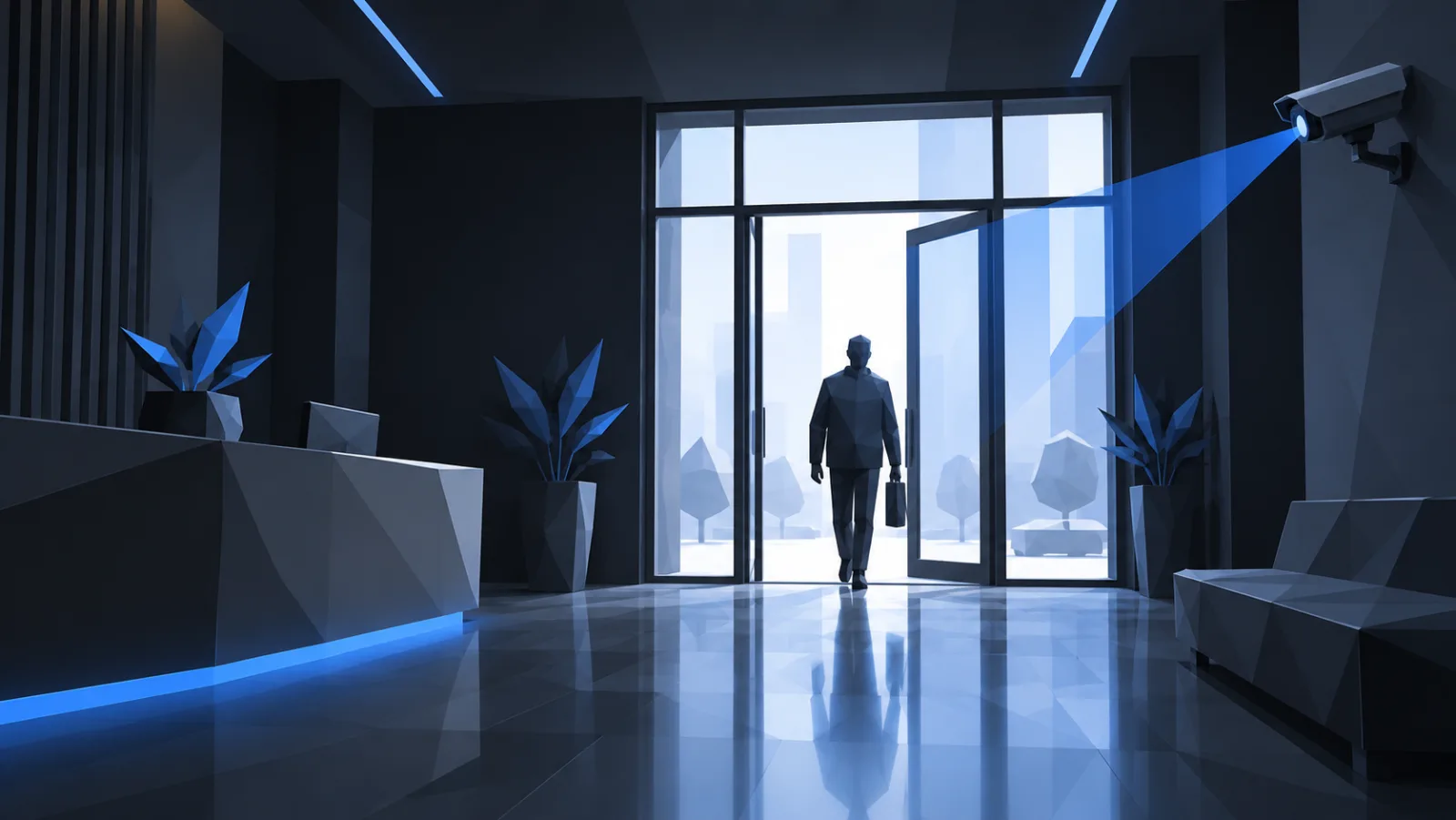
The most common failed camera in a building is the one at the front door. It faces the glass, the street behind is ten times brighter than the lobby, and every visitor arrives as a black shape against a white rectangle. The sensor is fine. The scene simply spans more brightness than one exposure can hold.
Dynamic range
A sensor records a range of brightness from the darkest level it can separate from noise to the level at which it saturates. An ordinary sensor manages roughly 60 to 70 dB, a thousand to three thousand to one. A lobby with a sunlit street through the door is more like 100,000 to one. Something has to give: expose for the street and the lobby is black; expose for the lobby and the door is a white hole.
What WDR does
Wide dynamic range cameras capture the scene twice or more per frame at different exposures, a short one for the bright parts and a long one for the dark, and merge them. Good implementations quote 120 dB or 140 dB and make the visitor's face readable against the window. Cheaper ones apply a tone curve to a single exposure, sometimes sold as digital WDR, and mostly lift the shadows into grey mush.
Two side effects matter on a drawing. Multi-exposure WDR halves the effective frame rate on some cameras, and it smears fast motion where the exposures disagree, so a person walking briskly through the door can show a ghost edge. Neither is a reason to skip it at an entrance; both are reasons to keep the lens narrow and the person large in frame.
Or change the geometry
Often the better fix costs nothing. Turn the camera so the glass is beside the view instead of behind the subject: a camera on the side wall looking across the entrance sees the visitor lit by the same daylight rather than against it. Or move the camera inside the second set of doors, where the vestibule has tamed the contrast. The drawing shows the glazing; the north arrow says when it will be a problem.
Where WDR belongs
- Any camera facing an exterior door or a window.
- Loading bays and vehicle gates, where the inside is dark and the outside is sky.
- Car park entrances, where headlights point at the lens at night.
- Under a canopy or an awning looking out.
Mark those cameras in the schedule. A WDR model costs a little more and a camera that only ever records silhouettes costs the whole install.