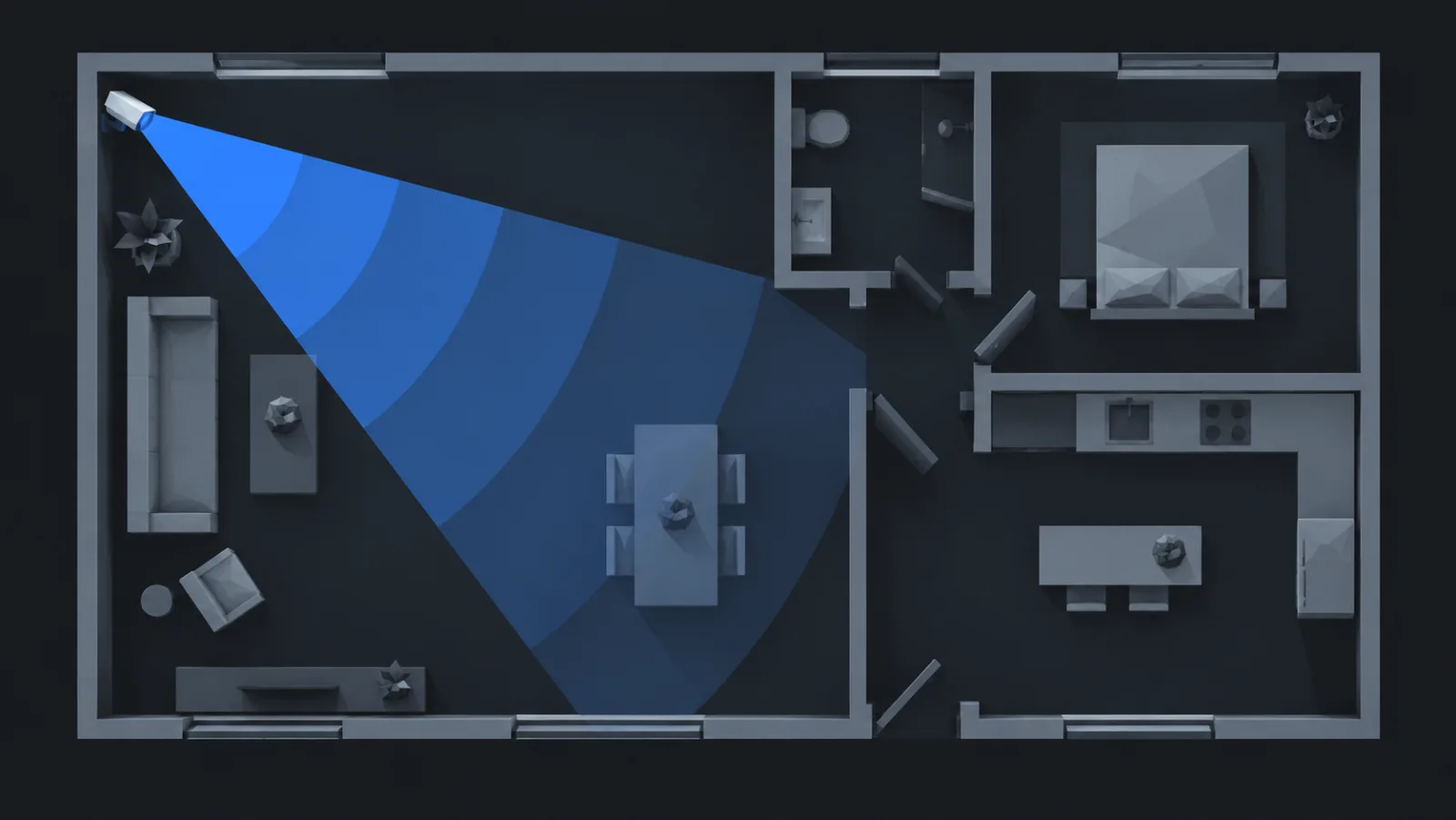
Every serious camera datasheet lists four distances under the heading DORI. They look like marketing, and vendors do quote them generously, but the definitions underneath are a standard, and once you know the rule you can check any of them yourself.
Four levels, four pixel densities
DORI comes from IEC EN 62676-4, the part of the video surveillance standard that deals with operational requirements. It defines what an operator needs to be able to do with an image, and ties each task to a minimum image density on the target, measured in pixels per metre at the target's distance:
- Detect: 25 px/m. Enough to tell that something is there and moving.
- Observe: 62.5 px/m. Enough to describe clothing and what a person is doing.
- Recognise: 125 px/m. Enough to say with confidence that this is a person you have seen before.
- Identify: 250 px/m. Enough to establish identity beyond reasonable doubt, which in practice means a usable face.
The figures are for the horizontal axis. A person 1.7 m tall standing at the identify distance occupies about 425 pixels of image height on a camera with a 16:9 sensor, which is why the face is legible.
Where the distance comes from
Pixel density falls off linearly with distance. If a camera has W horizontal pixels and a horizontal field of view of α degrees, the width of the scene at distance d is 2 · d · tan(α / 2), and the density is the pixel count divided by that width. Solve for the distance at which density equals a DORI threshold and you have the range:
d = W / (2 · tan(α / 2) · density)Take a 4 MP camera, 2560 pixels wide, with a 2.8 mm lens giving about 105° horizontal. The scene at 10 m is 26 m wide, so the density is 98 px/m: past observe, short of recognise. The identify range works out to about 3.9 m. That is the honest number for a wide-angle lens, and it is why entrance cameras meant to identify faces use a narrower lens or sit much closer than people expect.
What the datasheet leaves out
The standard defines density only. Lighting, motion blur, compression, the angle of the face to the lens, and whether the person is wearing a hood are outside it. A camera can meet 250 px/m at 12 m and still produce nothing usable at night at that distance. Treat DORI as the ceiling: the best the optics allow under good conditions.
Vendors also compute their published DORI from the sensor's full width, which is right for a fixed lens and optimistic for a varifocal one quoted at its longest setting. If you plan to run the lens wide, use the wide-end number.
Using it on the plan
The useful move is to draw the four distances as rings inside the camera's cone, so the plan shows which zone each part of the room falls into. A doorway that sits inside the identify ring is covered for evidence. A car park that sits in the detect ring is covered for alarms and little else. When a client asks "will we be able to see who did it?", the ring answers the question before the camera is bought.
In CameraCAD the rings are drawn from the catalog record for the model you placed, at the lens setting you chose, and they are cut by the same walls that cut the cone. Where the manufacturer publishes DORI, the record carries it; where they publish only the field of view, the rings are computed from the formula above.