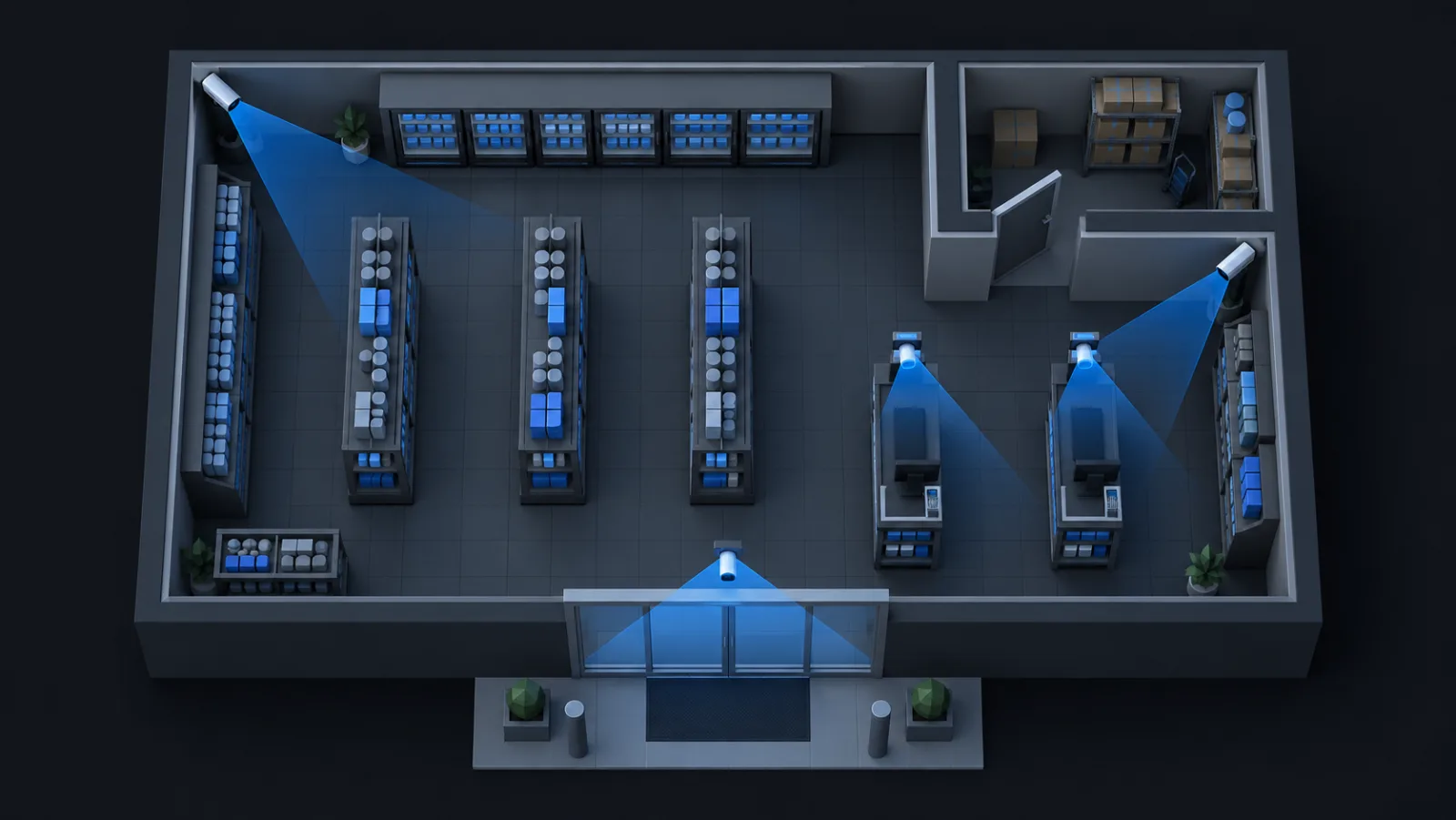
Retail is the most common camera brief and the most often over-drawn. The temptation is to paint the whole floor in coverage; the useful plan starts from the four or five places where a recording is later needed, gets identify quality there, and only then fills the rest with observe.
1. The entrance, facing in
Everyone who enters passes through one gap, facing the same way, at a predictable distance. A camera inside the shop, looking back at the door at head height plus a little, mounted so the person is 3 to 5 m away when they cross the threshold, gets a full face at identify quality in daylight. Use a lens narrow enough to fill the frame with the doorway: 4 mm for a single leaf at 4 m, 6 mm from further back. This one camera answers more incident queries than the rest of the system together.
Two things to draw: the door swing, so the leaf does not hide the face on entry, and the glass, so the camera looks with the daylight rather than into it. If the door faces west, the camera tilts down a little more, and a wide-dynamic-range model is worth the money.
2. The till, from behind the customer
The till camera has two jobs: the customer's face and hands, and the drawer. One camera above and behind the customer's shoulder, looking toward the cashier, sees both, plus the screen if it is angled well. A second camera over the cashier, looking down at the drawer, covers internal loss. Neither needs to be wide; both need to be close. Mounting at 2.6 to 3 m keeps faces readable.
3. The stock room and the back door
Staff-only doors are where stock leaves. A camera inside the stock room facing the door to the shop, and one facing the delivery door, both at identify range, close that loop. The corridor between them takes a corridor-format camera if it is long.
4. High-value shelves
Spirits, razors, cosmetics, electronics. Each bay gets a camera at the aisle end looking along it, so a hand reaching for the shelf is seen from the side, at observe quality at least. A dome in the ceiling looking straight down shows the top of a head and settles nothing.
5. Everything else, at observe
Once the choke points are placed, the remaining floor needs only enough coverage to follow a person from one identify camera to the next. Wide lenses, high mounting, observe quality. This is where a fisheye in the middle of the floor earns its place, and where the blind-spot view shows the gaps worth closing with one more camera rather than three.
A worked layout
A 220 m² convenience store, single entrance, two tills, stock room at the back with a delivery door:
- Entrance: one 4 MP turret, 4 mm, inside at 2.8 m, looking at the door from 4.5 m. Identify.
- Tills: one turret behind each customer position, 2.8 mm at 2.6 m; one dome over the counter looking down at both drawers.
- Stock room: one turret facing the shop door, one facing the delivery door, both 2.8 mm, both at identify range for their door.
- Spirits bay: one turret at the aisle end, 4 mm.
- Floor: one fisheye at the centre of the sales floor for observe coverage and tracking.
Nine cameras. Drawn on the plan with their cones cut by the shelving runs, the blind-spot view shows two corners behind the chiller that nobody stands in and the walkway behind the tills. Leave the corners; add a tenth camera for the walkway. That decision, made on the drawing, is what the plan is for.