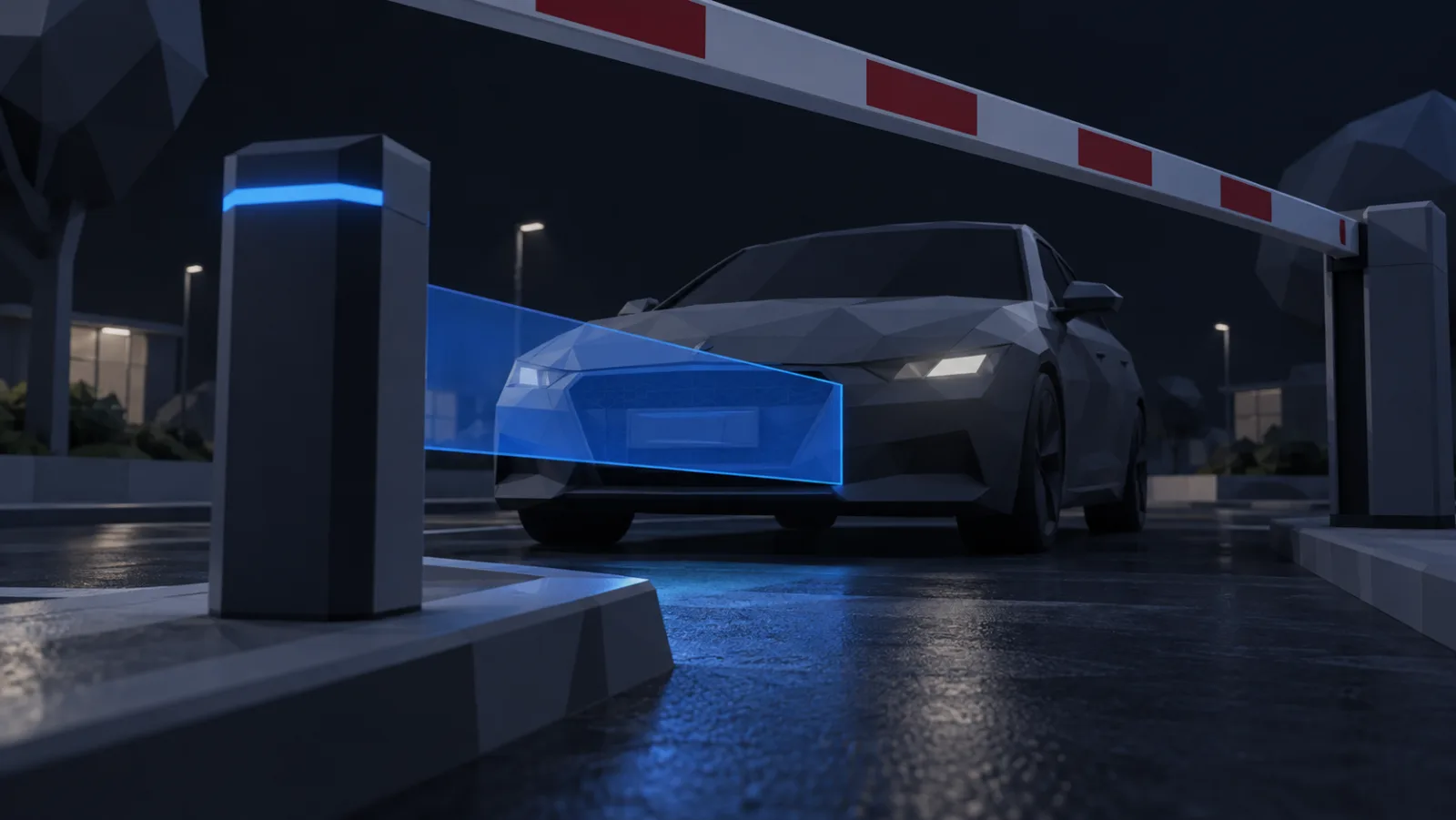
Plate recognition fails on site far more often than it fails in software. The camera sees the plate, but at too steep an angle, too small, too blurred, or bleached by the headlights beside it. Each of those is geometry, and geometry is decided on the plan.
Pixels on the plate
Recognition engines want the characters at least 20 pixels tall, more for reliability; a European plate 520 mm wide at that character height means roughly 130 to 200 pixels across the plate. Work back to pixels per metre: a plate is about half a metre, so 130 pixels across it is 260 px/m, which is the identify threshold in DORI terms and no coincidence. At a 2 MP camera's 1920 pixel width that density holds only where the scene is 7 m wide, which at a 30° lens is about 13 m from the camera. Narrower lens, longer reach; the capture zone is always a short band.
Angle
Characters foreshorten. Past about 30° horizontally, or 30° vertically, the engine starts guessing between 8 and B. A camera on a 6 m pole looking at a lane 10 m out is 31° down; on a 3 m pole it is 17°. Lower, closer to the lane and pointed straight along it is the recipe, which is why plate cameras sit at bumper height on bollards and why a camera meant for the whole car park is the wrong camera for plates.
Shutter
A car at 30 km/h covers 8 mm in a millisecond. A 1/50 s shutter smears a plate across 170 mm, which is a third of its width. Plate cameras run 1/1000 s and faster, which starves the sensor of light, which is why they carry their own infrared illuminator tuned to the retro-reflective plate. At night the image is a black frame with a bright, sharp rectangle in it; the car is invisible and the plate is perfect. A second camera provides the overview.
Headlights
Head-on, the headlights are the brightest thing in frame by orders of magnitude, and a normal camera's exposure clamps down until the plate is a grey smudge. Plate cameras counter with the fast shutter, a narrow IR pass filter that discards the visible glare, and wide dynamic range. Placement helps: 10 to 15° off the lane axis keeps the beams out of the lens without foreshortening the plate much.
The capture zone
Put all of it together and each plate camera has a small box on the plan where it works: 3 to 4 m long, one lane wide, at a set distance. Draw that box. Where the lane bends, where cars stop at a barrier, where they queue: the box goes where the plate will be square to the lens and moving slowly, ideally stopped. A barrier or a speed hump is a better recognition aid than any lens.
Checklist for the drawing
- Lane width and direction of travel, so the box is oriented.
- Camera height, offset from the lane axis, and distance to the box.
- The lens that puts 250 px/m in the box.
- A second, ordinary camera for the vehicle and the driver.