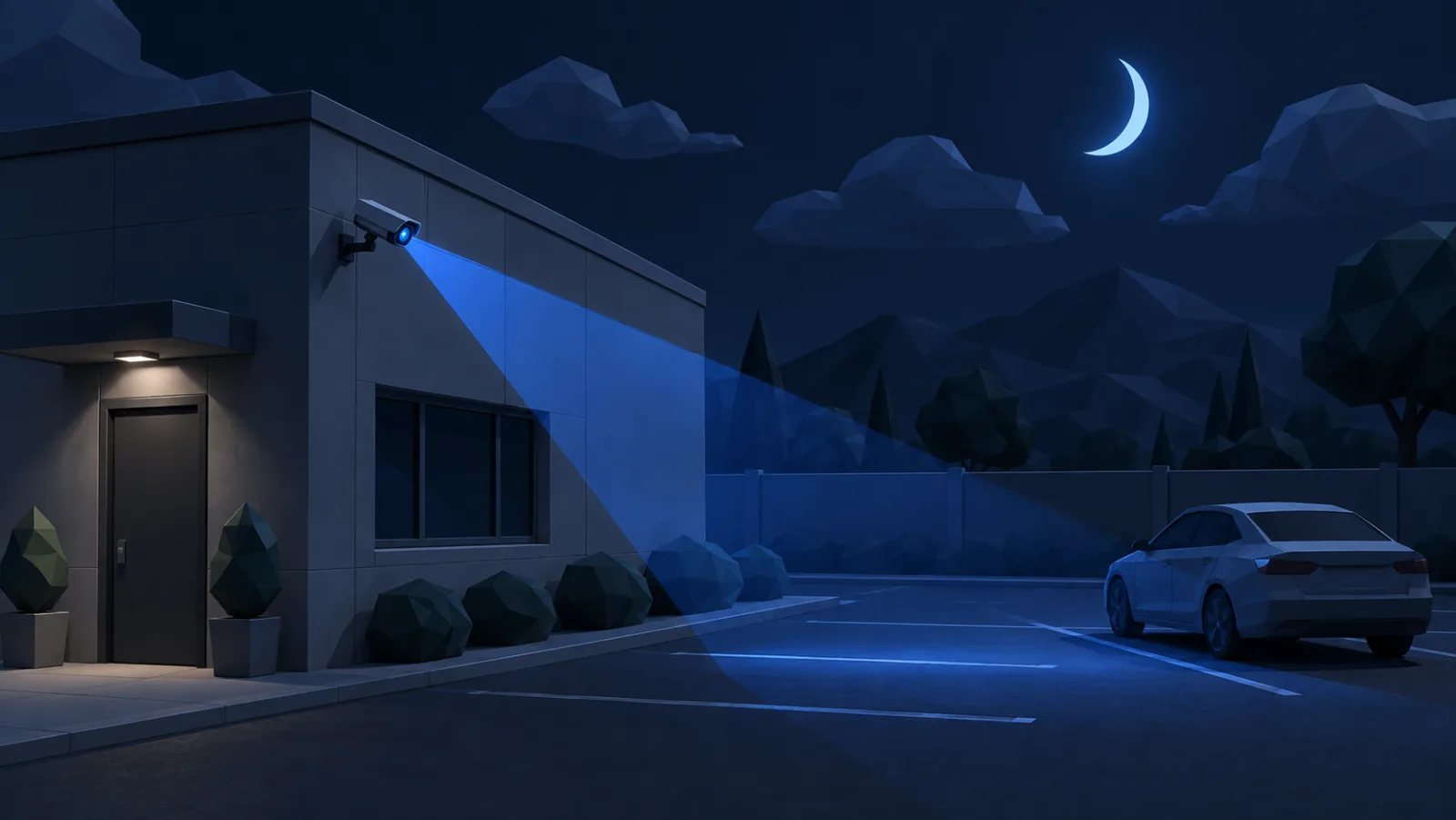
Every datasheet quotes a minimum illumination, and the numbers keep getting smaller: 0.01 lux, 0.001 lux, 0 lux with IR. They are measured under conditions the vendor chooses, at whatever noise level and frame rate the vendor accepts, and they say very little about whether a face will be legible at the back door at 2 a.m.
Lux, briefly
Lux is light arriving on a surface. Full daylight is around 10,000 to 100,000 lux, an office 300 to 500, a lit street 5 to 20, a full moon 0.1 to 0.3, an overcast moonless night well under 0.01. The datasheet figure is the level at which the sensor still produces an image the vendor is prepared to call usable, usually at the lens's widest aperture and often with the shutter slowed to 1/8 s or less. At that shutter a walking person is a smear.
The exposure trade
A sensor collects light three ways: a bigger aperture, a longer shutter, or higher gain. Aperture is fixed by the lens. Longer shutter means motion blur. Higher gain means noise, which the encoder then spends its bit rate on, so the recording gets both grainier and larger. Low-light performance is a decision about which of the three to sacrifice, and it varies by scene; the honest test is to look at the camera's night image of something moving at the distance you care about.
Infrared
Built-in IR LEDs light the scene at 850 nm, which the sensor sees and the eye does not. The datasheet gives an IR range, 30 m say, and it is a real number for a target straight ahead in open air. Three things shorten it:
- Angle. The LEDs throw a cone roughly matching the lens. Objects at the edge of a wide view get a fraction of the light.
- Reflection. A wall, a pillar or a ceiling close to the camera bounces the IR straight back and the auto-exposure closes down for the bright foreground, leaving the far end black. Rain and fog in front of the lens do the same.
- Contrast. IR is monochrome. A dark jacket and a dark wall become one shape.
Plan the IR range as half the datasheet figure at the edges of the cone and the full figure only down the middle.
White light and the alternatives
A lit scene beats every sensor trick. Where a light fitting can be added, add it, and put its position on the drawing so the camera looks with the light rather than into it. Where it cannot, cameras with built-in white LEDs give colour at night at short range, and thermal cameras detect at long range with no light at all, at the cost of ever identifying anyone.
On the plan
Mark which cameras rely on IR and the range you are assuming; the cone stays the same, but the identify ring shrinks after dark and the client should see that. Note the light fittings, and note the glass: IR bounces off a window pane, so an indoor camera looking out through glass at night sees its own LEDs and nothing beyond.