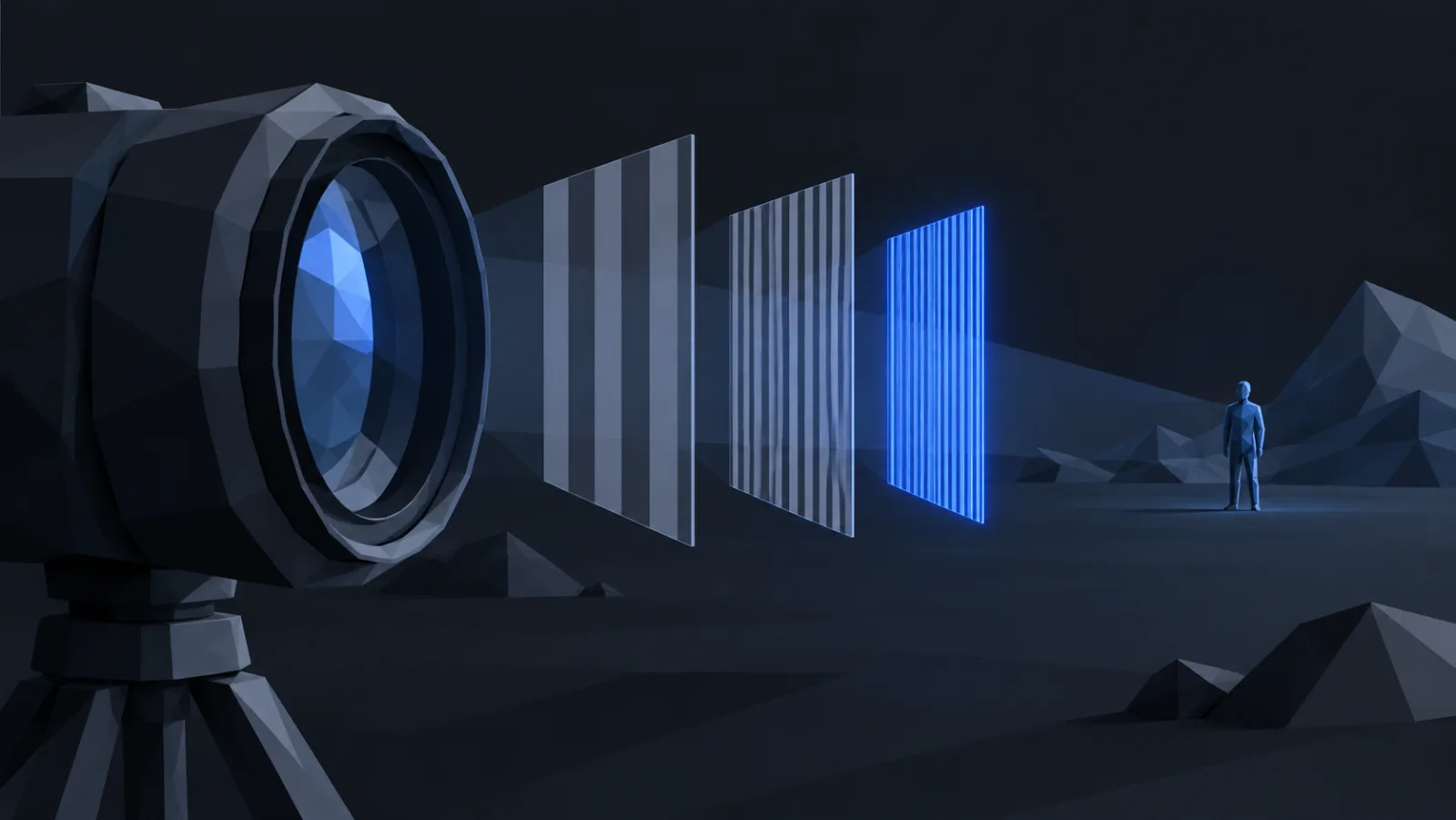
Put a visible-light camera datasheet next to a thermal one and the numbers stop making sense. The 4 MP bullet detects a person at 60 m; the thermal camera with a fraction of the pixels detects one at 500 m. Neither vendor is lying. They are answering different questions, and the thermal one is using a yardstick from 1958.
Where it comes from
In 1958 John Johnson, working on image intensifiers for the US Army's night vision laboratory, asked trained observers to find military targets through equipment of varying resolution. He expressed resolution as line pairs — one dark bar and one light bar — across the target's critical dimension, usually its smallest one, and measured how many line pairs the observers needed to reach a 50% chance of success at each task:
| Task | Question answered | Line pairs across the target |
|---|---|---|
| Detection | Is something there? | 1.0 ± 0.25 |
| Orientation | Which way is it facing? | 1.4 ± 0.35 |
| Recognition | What class of thing is it — person, car, animal? | 4.0 ± 0.8 |
| Identification | Which kind — a man with a rifle, a van rather than a car? | 6.4 ± 1.5 |
A line pair needs at least two pixels to draw, so on a modern sensor the criteria are usually quoted in pixels: about 2 for detection, 8 for recognition and 13 for identification. Thermal vendors commonly round to 1.5, 6 and 12 pixels. Always look for which set a datasheet used; it moves the range by a quarter.
Working out a thermal range
The footprint of one pixel at distance d is the pixel pitch p scaled by d / f, where f is the focal length. Ask for n pixels across a target of critical dimension D and solve:
d = D · f / (n · p)Take a common uncooled core: 384 × 288 pixels at 17 µm pitch behind a 25 mm lens. A standing person is taken as 1.8 × 0.5 m, critical dimension about 0.75 m. Then detection at 2 pixels is 0.75 × 0.025 / (2 × 0.000017) ≈ 550 m, recognition at 8 pixels ≈ 140 m, and identification at 13 pixels ≈ 85 m. That is what the datasheet prints, and it is arithmetic, not optimism.
It is also a probability at the limit of perception. At 550 m the person is two warm pixels. A trained operator watching live, told where to look, says "yes, something" half the time. An analytics engine running on the stream wants more, and a court wants a great deal more.
Johnson against DORI
DORI (explained here) measures the same idea in pixels per metre across the whole scene. Put the two on the same target and the gap is plain:
| Johnson, pixels on a 0.75 m target | DORI, pixels on the same 0.75 m | |
|---|---|---|
| Detect | ≈ 2 | 19 (25 px/m) |
| Recognise | ≈ 8 | 94 (125 px/m) |
| Identify | ≈ 13 | 188 (250 px/m) |
The words match and the thresholds differ by ten times or more, because the tasks differ. Johnson's "identify" tells a tank from a truck. DORI's "identify" names a person from their face. A thermal camera will never identify anybody in the DORI sense at any range: faces carry very little thermal contrast, and even up close the image does not show who someone is.
Using both on one plan
- Use thermal for what it is good at: detection along fences, across open ground and in darkness, feeding alarms. Plan it with Johnson ranges, taking the detection range as the outer limit of an alarm zone, not as coverage.
- Use visible cameras, with DORI, where the alarm has to become evidence: gates, doors, the places a person must pass.
- Never put a Johnson range and a DORI range side by side in the same table for a client without saying which is which. The thermal camera will look ten times better, and it is not.
- Weather counts. The Johnson figures assume clear air. Fog, heavy rain and heat shimmer over tarmac shorten thermal range sharply, and most datasheets do not say by how much.
In CameraCAD the DORI rings on a camera come from the catalog record for its lens and sensor. Thermal heads are kept apart from visible ones in the catalog record, so their ranges never feed the DORI rings, and the glossary keeps the two vocabularies apart.