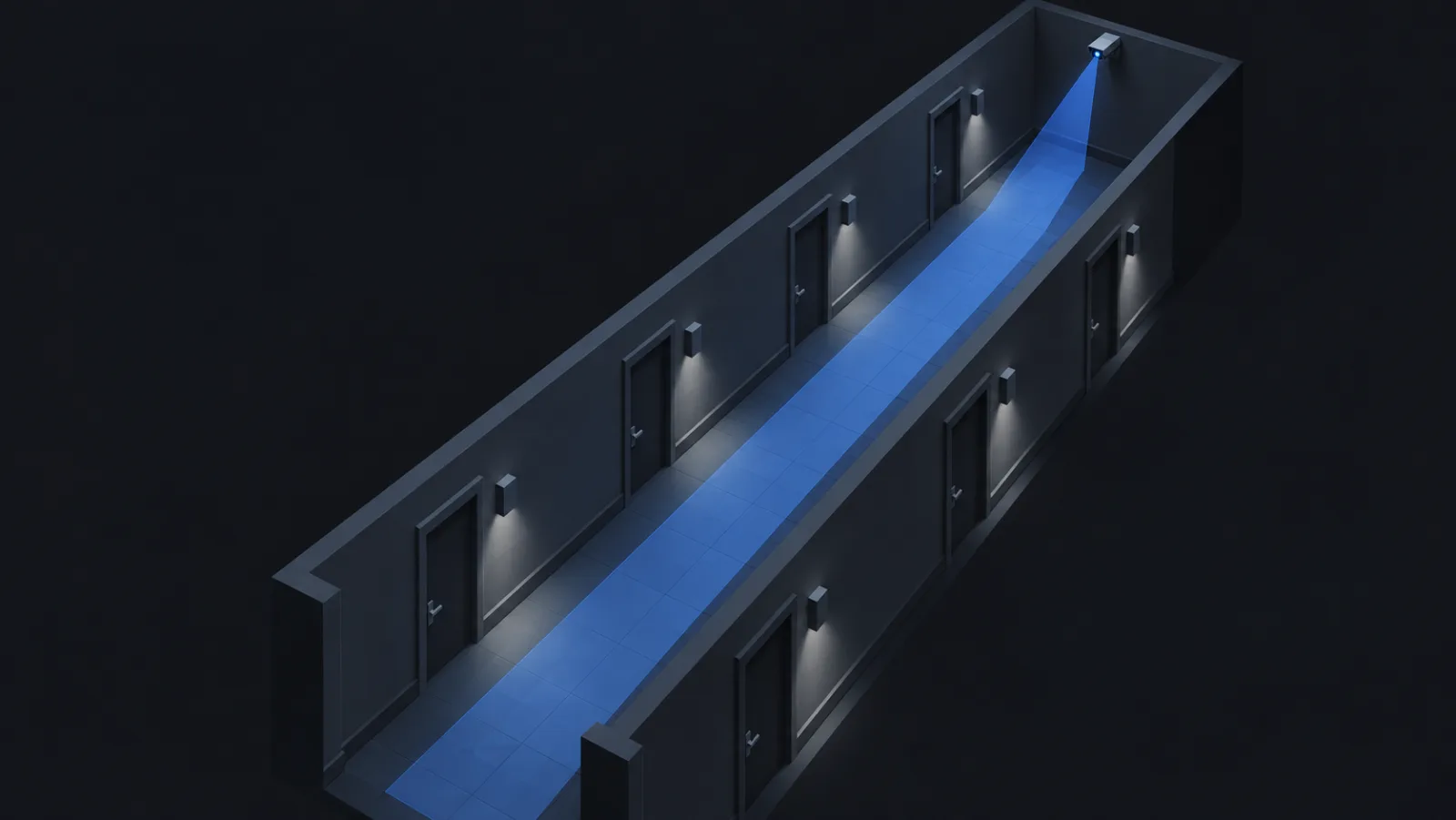
Sensors are wide. A 16:9 image is nearly twice as wide as it is tall, which suits a car park and wastes most of itself on a corridor: a strip of floor in the middle and two bands of wall on either side. Corridor format is the fix, and most professional cameras have supported it for a decade.
What it is
The camera rotates the image 90° before encoding it, so the recorder receives a 9:16 frame. On a dome the sensor is physically rotated inside the housing; on a bullet the whole camera is mounted on its side; on newer models it is a menu option and a motor. Either way the result is a tall image with the corridor running down its length.
What it buys
Consider a 4 MP camera, 2560 by 1440, looking along a 2 m wide corridor from one end. In landscape, the 2 m width fills perhaps 800 of the 2560 horizontal pixels once the corridor is a few metres out; the other 1760 columns look at the walls. In portrait, the 1440 short side spans the width, and all 2560 long-side pixels run along the corridor's length. The pixel density on a person walking toward the camera roughly triples at any given distance, which moves the identify range out by the same factor.
Where it applies
- Corridors, obviously, and stairwells looked at from the landing.
- Aisles in a warehouse or a supermarket, when the camera sits at the aisle end.
- Platforms, fence lines and roads seen from a pole at one end.
- Doorways seen from the side, where the height of a person matters more than the width of the door.
Where it hurts
The wide view across a room is gone, so a corridor-format camera at the end of a lobby covers the path to the lift and misses the seating either side. The cone on the plan is the same wedge either way; what changes is the pixel density along it. Draw the cone with the rotated field of view, mark the format in the schedule, and check that the monitor wall can display a portrait tile, because a 9:16 stream squeezed into a 16:9 tile is the complaint you will hear first.