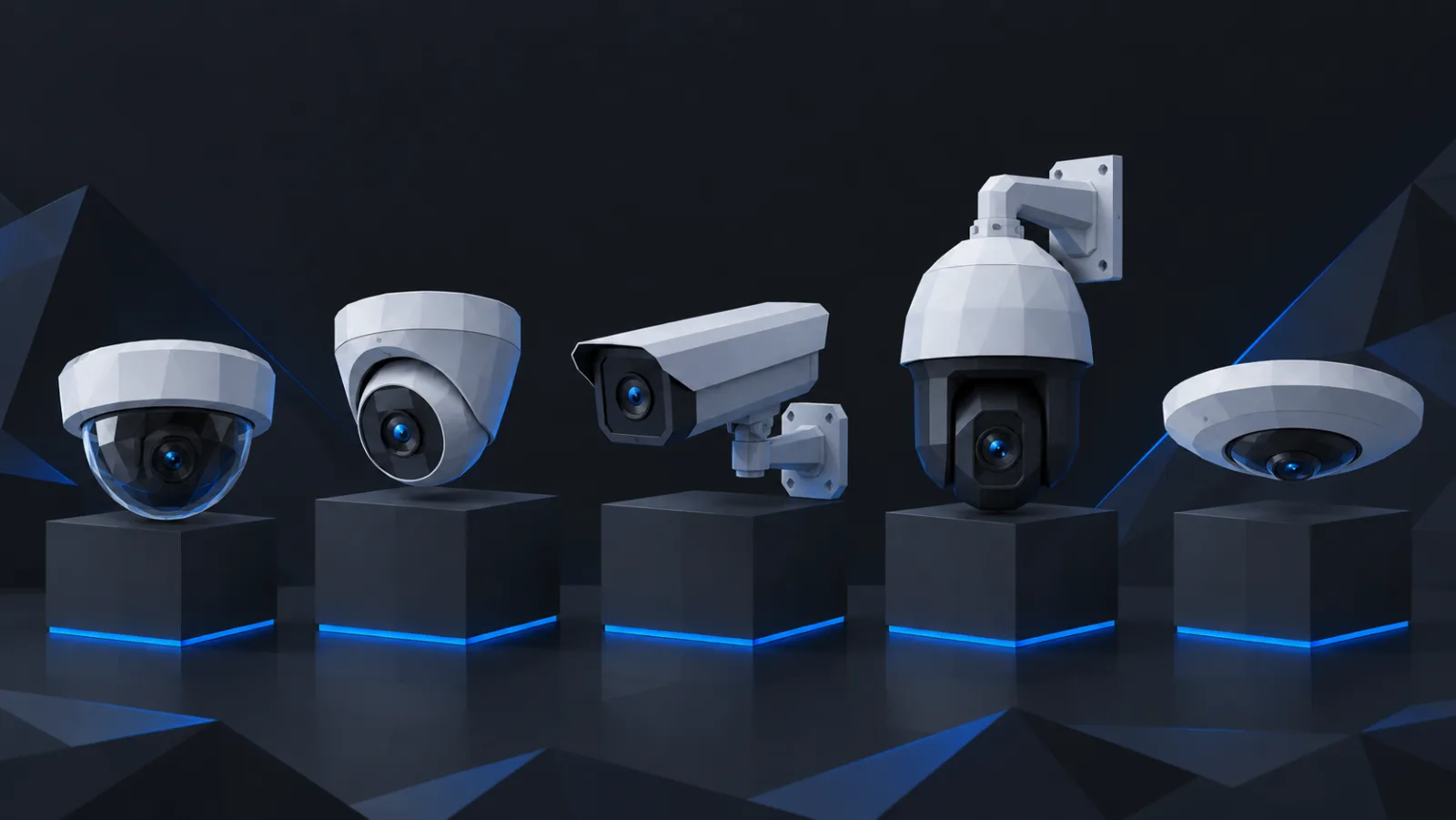
Behind the housing, most cameras of a given generation share the same handful of sensors and lenses. The housing decides where the camera can be mounted, how it survives its surroundings, and how it is read by the people under it. Choose it for those reasons.
Dome
A hemisphere of polycarbonate over a camera that can be aimed inside it. Vandal-resistant when rated, discreet, and the line of sight is hard to read from below, which is the point in retail. The bubble costs a little sharpness and a lot at night: built-in IR reflects off the inside of the dome unless the foam gasket seats perfectly, and a scratched or dirty bubble scatters it further. Mount on a ceiling or a soffit, keep the dome clean, and expect to replace bubbles in harsh environments.
Turret
The eyeball in a socket: a small ball with the lens and IR in front, swivelling in a base. It aims like a dome, mounts where a dome mounts, and has no bubble, so IR performs as the datasheet says. It is less vandal-resistant and the lens is exposed to the weather, but under an eave or indoors it has become the default for most small installs, and for good reason.
Bullet
A cylinder on a bracket. The shape carries a longer lens and a bigger IR array, so bullets reach: fence lines, car parks, the far end of a yard. They are also the most visible and the easiest to knock askew, and the bracket needs a flat wall or a pole. Where a client wants a visible deterrent, a bullet is the honest choice.
PTZ
Pan, tilt, zoom: a motorised camera that an operator or a preset drives. A single PTZ can read a number plate at 200 m and then swing to the gate. It can also only look one way at a time, and while it is zoomed on the gate, the yard is unrecorded. Treat a PTZ as an operator's tool on top of fixed coverage, never as a replacement for it, and draw its cone at the widest zoom for the coverage plan.
Fisheye and multi-sensor
A fisheye sees a full 360° from the ceiling with one lens and a heavily distorted image that the recorder dewarps. It covers a room's floor with essentially no blind spot under it and identifies nobody past a few metres. A multi-sensor unit is two to four ordinary cameras in one housing, each with its own lens, aimed independently; it covers a junction of corridors or a car park from a single pole and produces separate streams. Both save mounting points, cabling and licences; neither replaces the fixed camera at the door that has to see a face.
Rating the housing
Two numbers on the datasheet: IP for water and dust, IK for impact. IP66 or IP67 for anything outdoors; IK10 wherever a hand or a bat can reach. Indoors under a high ceiling, neither matters and the money is better spent on the sensor.
Choosing
- Indoor ceiling, discreet: dome.
- Indoor or sheltered, IR at night: turret.
- Outdoor, long reach, visible: bullet.
- Large open area with an operator: PTZ over fixed cameras.
- Whole-room overview from one point: fisheye, with fixed cameras for the doors.